Sengere, R.W., Curry, G.N., Koczberski, G. & Labun, M.
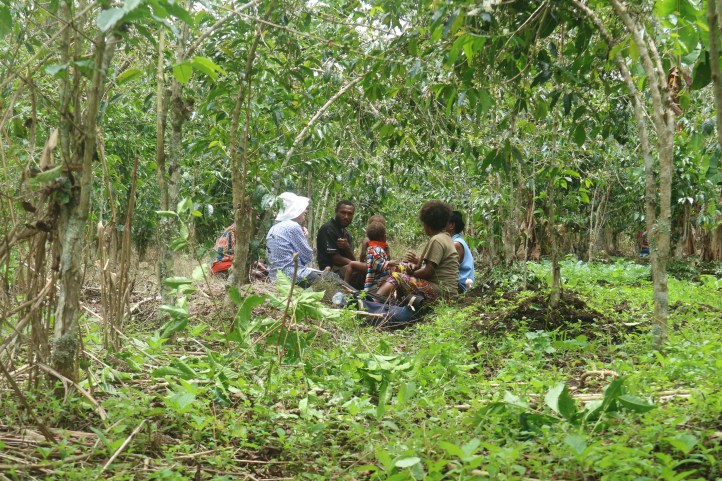
Extension and advisory services are critical to enhancing the skills and knowledge of smallholder coffee farmers to increase productivity and consistently produce quality coffee. In PNG, the merging of the Coffee Development Agency (CDA) with other coffee agencies to create the Coffee Industry Corporation (CIC) has resulted in very high ratios of farmers to extension officers. The shortage of extension officers has meant that the adoption of available extension information and new technologies has been weak among smallholders. Recent research published in the PNG Coffee Journal provides an assessment of past and current coffee extension approaches in PNG and suggests alternative approaches are needed to address previous failures.
Agricultural extension is a two-way communication of information to improve farm productivity and the income of farmers. Coffee extension approaches have evolved since large-scale production began in the 1950s in Papua New Guinea. Various approaches have been tried including Training and Visit, Coffee Management Divisions, Coffee Training Points and Farmer Demand Driven Extension to disseminate technologies and communicate coffee information. However, these approaches have had limited success with no significant improvement to the industry.
The PNG coffee industry requires long-term and sustainable extension strategies to revitalise and sustain the industry. Farmer Driven Demand Extension has merits in that it targets grower groups and hard-working coffee farmers who cultivate coffee as a business enterprise. However, industry evolution has given rise to collaborations through partnerships among coffee value chain participants that are improving production and ensuring a consistent supply of quality coffee to meet the demands of specific coffee markets. In high market access areas, chain leaders have stepped up their efforts to collaborate with smallholder coffee farmers and grower groups through the purchase of cherry and parchment coffee.
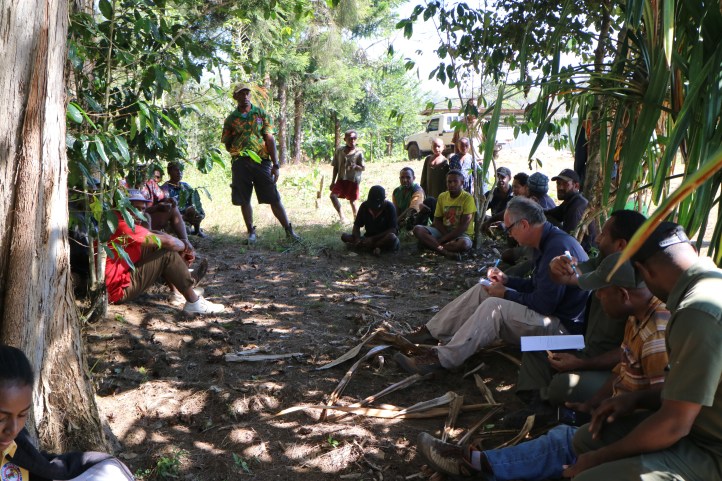
Providing extension and support services through grower groups and partnerships can be sustainable. Moreover, regular extension and advisory visits to farmers and grower groups can psychologically motivate farmers to work in their coffee gardens. The closer collaborations will develop stronger institutional leadership and advance group governance systems. The big farmers were instrumental as change agents in the early growth of the coffee industry and they remain active today. They have social networks, are influential, entrepreneurial and are located in the midst of smallholders; thus they can perform the role of extension agents or become focal points for development partners.
This research and the development of this research paper emerged under ACIAR-funded projects ASEM/2008/036 and ASEM/2016/100 and are discussed further in Sengere, R.W. (2016). The rise, fall and revival of the Papua New Guinea Coffee Industry [Unpublished PhD thesis] Curtin University. Other recent PNG Coffee Journal papers can be found here.
Full reference:
Sengere, R.W., Curry, G.N., Koczberski, G. & Labun, M. (2021). Market-driven Extension Services: targeted interventions to increase coffee productivity and improve quality among PNG smallholder farmers. PNG Coffee Journal 15(1), 39-48.
 Pacific Livelihoods