Linda Bina
The exhibition “String Craft: Bilum + Dilly Bags” was presented by Curtin University as part of the 2024 Indian Ocean Craft Triennial (IOTA 2024) and provided an opportunity to bring together indigenous fibre artists from Western Australia, Northern Territory and Papua New Guinea. The collection of nearly 100 works was co-curated by Anne Farren and Gina Koczberski, with the aim of promoting the value of indigenous practices through its focus on the PNG bilum and Aboriginal dilly bag. The curatorial team was supported by cultural advisors, Lea Taylor, an award-winning West Australian Aboriginal Artist with strong cultural connections to Bibbulmun boodja and Linda Bina, from Eastern Highlands Province Papua New Guinea who works as a researcher and heads the “Women in Coffee” section in the Coffee Industry Corporation of PNG.
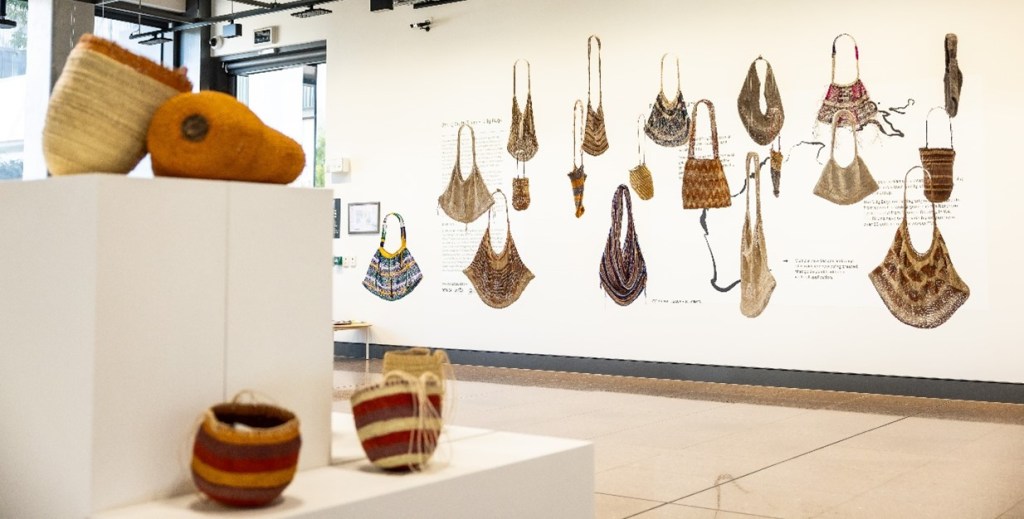
A key objective of the exhibition was to provide a platform through which the artists could share their knowledge and skills. This was achieved via a cultural exchange program which included activities led by Lea Taylor and Linda Bina. In this blog we interview Linda Bina on the value of these exchanges and her experience visiting Australia and working alongside indigenous artists.
Linda, why do you think these types of cultural exchanges are important?
Cultural exchanges allow people from different backgrounds to learn about and understand other cultures within their unique contexts. Through these exchanges, we gain insight into the behaviours, attitudes, and traditions that shape different societies. For example, during the floor talk, the significance of the bilum and dilly bags—primarily created, owned, and used by women—was highlighted as an integral part of our cultures. Papua New Guinean and Australian First Nations peoples each had distinct bilums and dilly bags, crafted using materials available in their environments. However, this traditional knowledge is being replaced in PNG with modern synthetic ropes. The exchange emphasized the distinction between the authentic, traditional bilum and its contemporary counterpart.
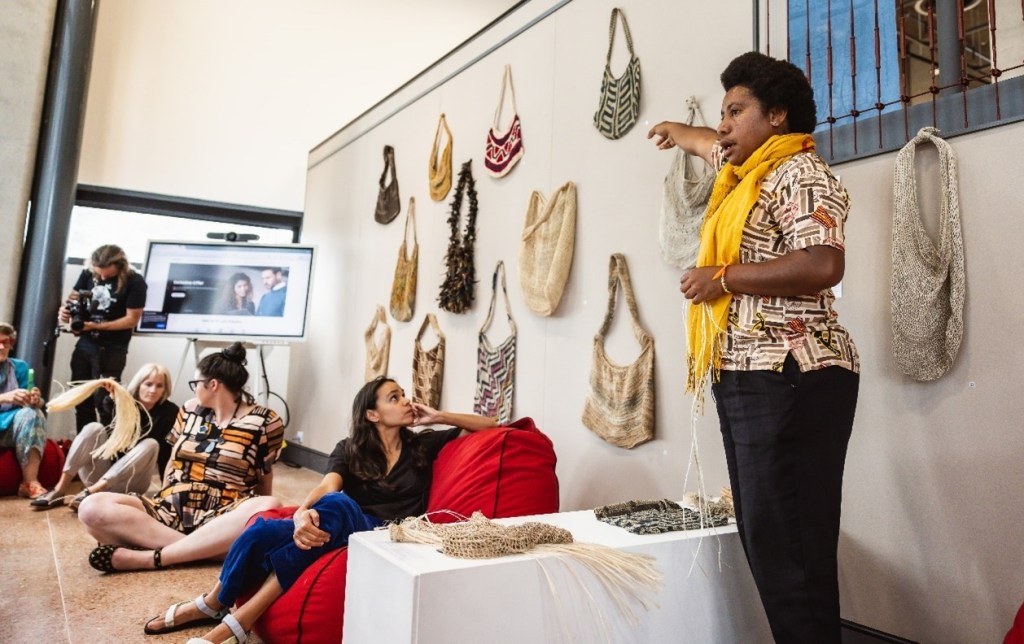
Such cultural exchanges foster a deeper understanding of the history and traditions that inform certain behaviours and attitudes within a culture. They also allow participants to connect with their heritage, appreciate their identity, and recognise the importance of passing on cultural knowledge to future generations. This particular exchange was especially valuable because it enabled visitors to see the connections between First Nations Australians and Papua New Guineans—our way of life, and the essential items like bilums and dilly bags that were vital to our existence.
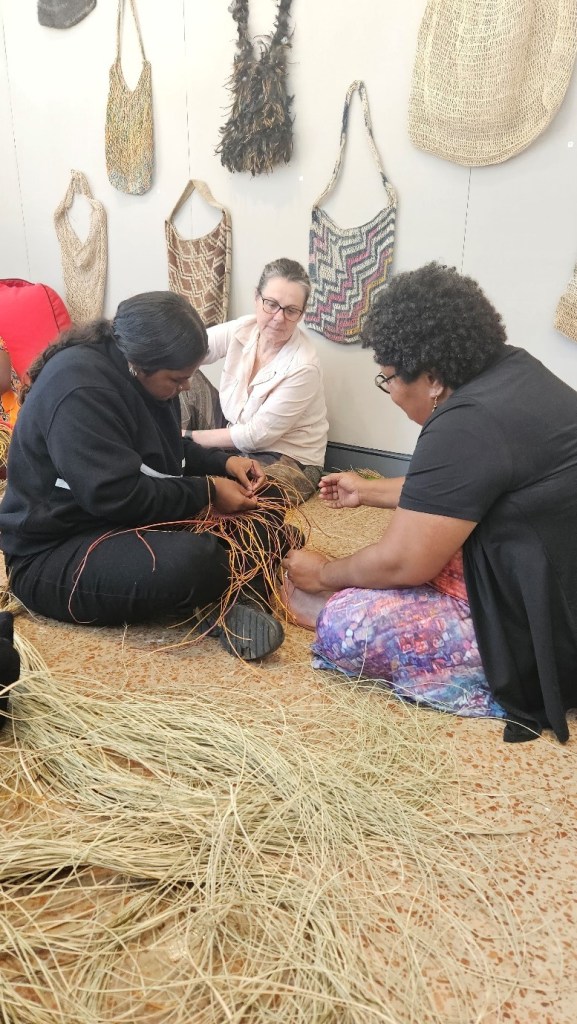
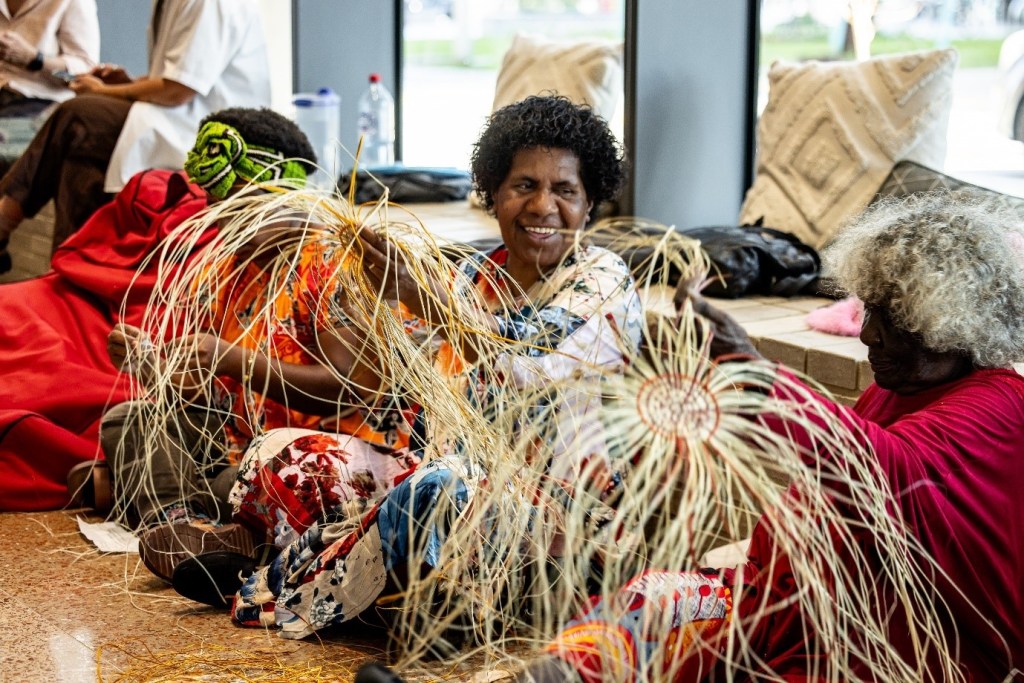
(Bula’Bula Arts, NT) (left front) and Julie Baleu (PNG) (right front) learning together in the cultural exchange workshop.
How does the bilum benefit women in PNG?
Bilums and accessories have emerged as a powerful symbol of women’s identity in a multicultural society. Alongside our spoken languages, bilums are a daily reminder of cultural heritage. For PNG women, bilums are significant because they provide an opportunity to document, record, and share cultural experiences. They help connect children to their history and preserve cultural identity in the face of rapid westernisation. This, to me, is the greatest benefit, as the younger generation is increasingly losing touch with their cultural roots. Personally, I feel saddened by the fact that, as a Papua New Guinean, I have not learnt my own language and can barely make a bilum. It pains me to think about how I can’t teach my daughter something I do not know myself.
What did you personally gain from the overall experience?
The exhibition was an invaluable personal and professional experience. It marked my first time traveling internationally, which was transformative in itself. It helped me recognise the immense value of such opportunities, especially for individuals who might otherwise never experience life outside their own country. This journey broadened my perspective, inspiring me to envision possibilities for myself and the people I influence daily—women and girls in coffee-farming households, members of my bilum collective, and girls in my community. I gained invaluable skills in public speaking, panel discussions, and cultural exchange. Additionally, I acquired knowledge about dilly bags and their connections to First Nations cultures.
Perhaps most profoundly, I learned that lost knowledge is difficult to recover, underscoring the importance of preserving and celebrating our cultural heritage.
One special opportunity arising from my role as a cultural advisor was to work with Joyce Ale’o. Joyce is an agricultural labourer from Gimi, who was born and lives in Kotiufu, Eastern Highlands Province. She occasionally sells bilums to earn some extra cash. We commissioned Joyce to make a bilum dress for the exhibition. It was her first attempt to weave a bilum dress. It took weeks to complete the dress, sometimes with the help of other women in the village.
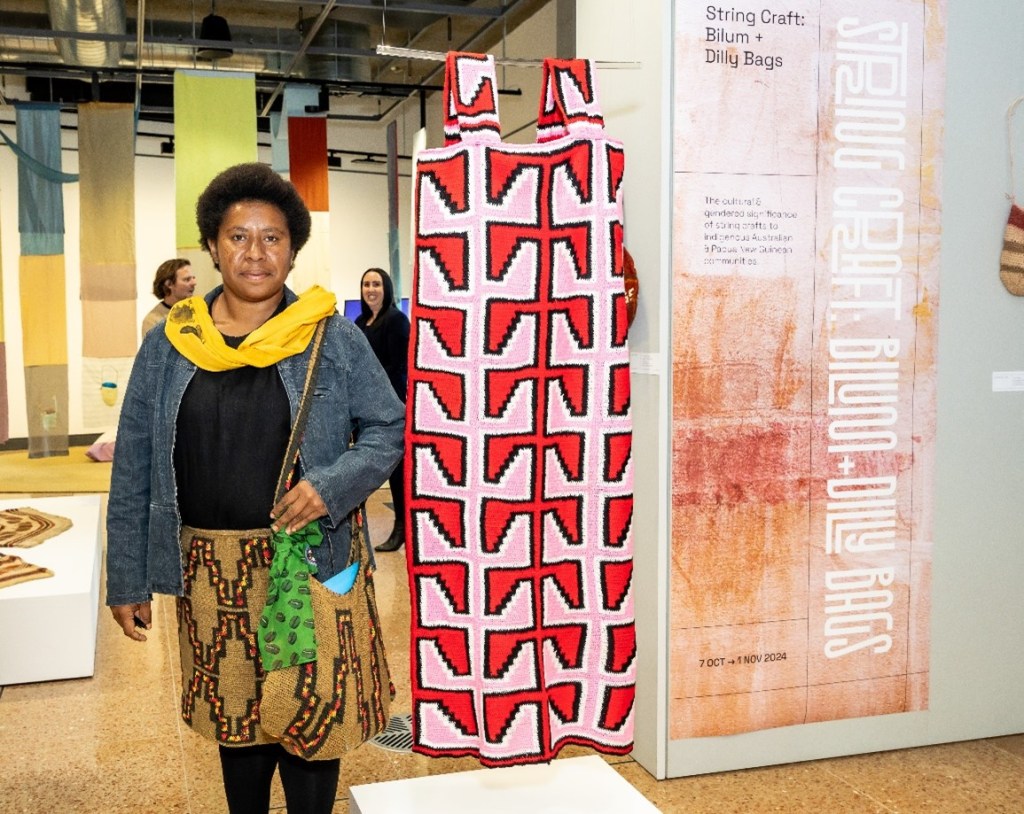
Joyce was very interested to apply her bilum making skills she learnt as a young woman to create a bilum dress and to experiment with new ways to use her traditional craft and maintain her cultural heritage.
Next year Linda will be joining the Pacific Livelihoods Research Group as a Masters student. In the meantime she will be meeting up with Anne Farren, Lea Taylor and Gina Koczberski when they travel to PNG in September to attend the Goroka Bilum Festival.
A short video documentary of the String Craft exhibition can be found at: https://youtu.be/0XAuAB36mD8

The exhibition was supported by the Indian Ocean Craft Triennial (IOTA24) and received funding from the Department of Local Government, Sports and Culture Industries (DLGSC) and Curtin University School of Design & the Built Environment Small Grants Program.
 Pacific Livelihoods