
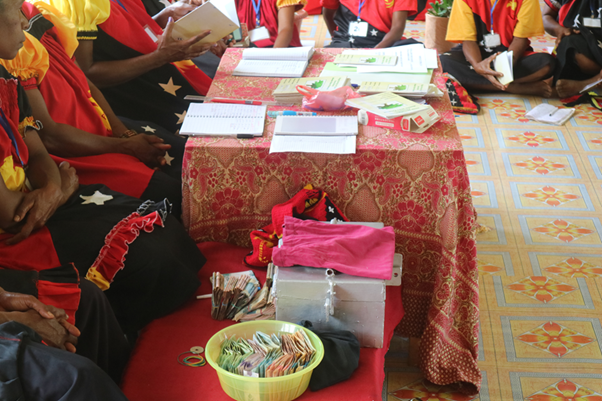
“Being a part of the VSLA (Village Savings and Loans Association) has taught me a lot, my plans and dreams for the future have grown. In the future what will I become? how will I live? The group is a good thing to help all of us to help each other. … now I can dream of a good future”.
In the rural highlands of Papua New Guinea, women face a range of economic challenges. Local economic opportunities are few, and there are strong gendered constraints on women’s economic activities. Women often have primary responsibility for providing for their children, but many women have limited control of the income they earn. Access to formal banking services is difficult, so few women have a place to save their money, let alone apply for a loan.
To address some of these challenges, researchers from Curtin University and PNG’s Coffee Industry Corporation in collaboration with CARE International in PNG, piloted Village Savings and Loans Associations (VSLAs) in four neighbouring rural villages in Unggai-Bena District of Eastern Highlands Province, Papua New Guinea. We found that the VSLA was able to help women to save, enabled access to credit which they were able to use to establish and maintain micro-enterprises, and many have been able to improve their material standard of living. But as the opening quote highlights, the most significant impact has been the expansion of women’s ‘horizons’, of what they imagine they are capable of, and their dreams for their future.
The findings from the pilot are published in a recent report, Financial inclusion, livelihoods and women’s empowerment: A case study of village-based savings groups in rural Papua New Guinea
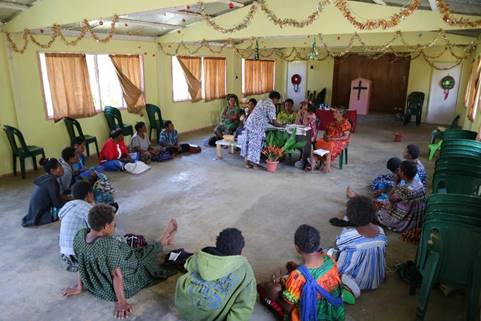
In the VSLA model – a model developed by CARE International – small groups of people regularly gather to save. Their savings are then used as a pool of money from which members take out micro-loans. Prior to the VSLA pilot, most women did not have a bank account or access to other formal financial services. The VSLA provided a ‘village bank’ for members and created a supportive environment for women to learn new skills, independently earn and manage their own income, and pursue new livelihood goals.
“[Before I joined the VSLA] when I counted coins I got from the market, I often made mistakes… [Now] I come and look and learn. It is a kind of school house of ours… I watch, and when they count I also sit down and count.”

The group’s high levels of savings and very low loan default rate was impressive and fostered women’s confidence and a greater sense of livelihood security. Many valued having more control over their income and a means to take their money out of circulation through saving.
“Big changes have occurred in our lives. I have built a house… My husband is also in the group. My husband and I both took loans, and we put it aside and bought corrugated iron… when I got money I saved it, when I got money at the share-out it helped us, and now we completed the house.”
From the perspective of women, the VSLA has been a driver of change. It has provided enabling pathways for them to improve household income security, engage in new forms of intra-household relationships and new identities and advanced their economic empowerment. These outcomes have been achieved by the women themselves driving and shaping the operations of the VSLA to meet their needs and goals.
“Some things we had dreamed of, with VSLA it looks like we can achieve them.”


The pilot was part of a four-year research project titled Identifying opportunities and constraints for rural women’s engagement in small-scale agricultural enterprises in Papua New Guinea. The project funding was provided by Australian Centre for International Agricultural Research (ACIAR).
Sharp, T.L.M., Koczberski, G., Bina, L., and Ryan, S. (2025). Financial inclusion, livelihoods and women’s empowerment: A case study of village-based savings groups in rural Papua New Guinea. Pacific Livelihoods Research Group, Curtin University, Perth. https://doi.org/10.25917/60nn-yk70